The Chums Of Chance In Venice, Or How The Cool Kids Played Tetris In 1902
(pp. 243-259)

Anamorphous image of Tetris creator Alexey Pajitnov.
The Plot
Returning to the Chums thread, we find Our Heroes in Venice, while The Inconveniece undergoes an upgrade. In keeping with the boy's-comic style, everything's gone Italian, the Chums are now "Gli Amici", the Inconvenience the Seccatura, and so on. The boys seem the same, Noseworth and Suckling continue their bickering, Miles lost in his own innocent agenda, moved by another occurence of the Picardy thirds. On a scouting misson, they come in over Murano, (famous for it's glass-blowers) and soon come across their target - the Isola Del Specchi, the Isle Of Mirrors itself. Once again, they find themselves followed by The Bol'shaia Igra, which raises suspicion among the crew - how do the Russians always know where The Inconvenience will be?

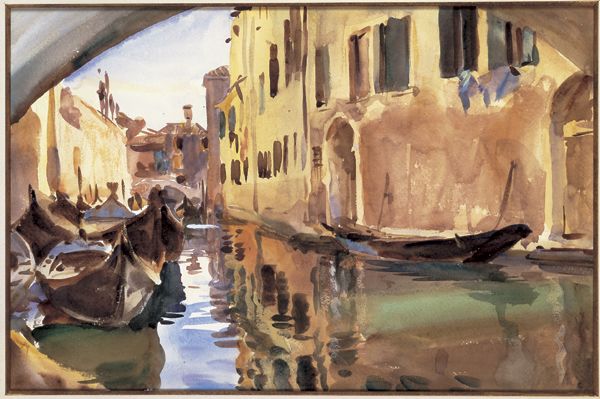
John Singer Sargent, "Small Channel In Venice". Source
On land again, the boys gather for dinner beside a little canal. Randolph ruminates out loud on his motivations, the first of many examples of the boys' desire for at least partial independence from their job in the sky. As Counterfly chats up the waitresses for information on Padzhitnoff, the Russians turn up in the very osteria (cafe) the Chums have chosen! The boys decide to stand their ground, and Randolph toasts all with their motto, "Red blood, pure mind".
The wineglasses turn out to have been a gift from Domenico Sfincuno, whose wish is to claim what he feels is his family's right to the Dogedom of Venice. Made ineligible for the Dogedom, the earlier Sfincuno family formed an alternate (to the Silk Road) trade route to the markets of the East, and the current Sfincuno hires the Chums to recover the lost route - the Sfincuno Itinerary - a "map or chart of post-Polo Routes into Asia, believed by many to lead to the hidden city of Shambala itself."

An anamorphoscope. Source
It turns out the Itinerary is more than a simple map (or route). In another example of light-trickery/duality, the Itinerary is suggested to be anamorphous (or more specifically "paramorphous" in nature, viewed with a specially-made mirror-device, ground at the time by the asylum-artisans of the Isola Del Specchi from... wait on it... Iceland spar. Is the Itinerary a map of real terrain, or of "the architecture of dream" (250:21)?
Miles, gazing at frescoes, finds himself inside "the prophetic vision of St. Mark, but in reverse" - he appears to/becomes a winged lion-being, who proclaims the Chum's current mission as a "pilgrimage", a serendipitous contract as part of a larger (in this case Christian) scheme of things.
Counterfly has a mysterious evening with a young woman, revealing a cigarette lighter that he claims "found him" from the future. The woman reads Tarot cards for him, and finds to her surprise The Campanile, the famous Venetian tower will be struck down soon. Counterfly spends the night, going AWOL in the morning. Suckling comes to fetch him, Counterfly speculates on a life on the ground. Returning to The Inconvenience, the crew tells them of Padzhitnoff's stocking his ship as if 'preparing for an engagement". In a fun moment, Pugnax invites a dog-friend on board in his native dialect, Dog.
Through a series of moment-flash descriptions, it becomes apparent there was a sky battle between The Inconvenience and The Bol'shaia Igra, seen by only the ubiquitous background figures (lasagnoni) in scenes such as these. There is another presence, "some visitation" during the battle, a "lethal impedance in the air". The battle rages, the Campanile comes into range, then Padzhitnoff "saw the ancient structure separate cleanly into four-brick groupings... rotating and translating in all available modes". The Campanile is falling - in the shape of a Tetris game!

The collapsed Campanile in 1902. Source
Randolph wonders remorsefully if one of their armaments ("sky-fish") could be the cause of the historic tower's fall. They meet with Padzhitnoff, who explains the destruction was caused by something else "out there". Talk turns to Japan, where it turns out one of the Chums previous employers was targeted for assassination by the Russians over their role in Manchuria. It becomes clear to the Chums that the Russians are after the Sfincuno Itinerary as well. Once again, routes and rails, connections from point-to-point in both geography and time come to the forefront, asking more questions than answering as the chapter comes to a close.
Notes And Comments
p243 Lots of bells in this chapter, from the bell-flowers (campanula?) in the opening passage to Miles comment on the loss of La Marangona, the largest bell in the now fallen Campanile
243:09 Convenient The Inconvenience drydocks in Venice, no?
p243 Scouting for the Isle Of Mirrors, looking below the surface for hidden meaning
245:37 - 246:06 Pynchon's description of the early evening, "Somewhere an accordian was wrenching hearts..." is another one of those passages, a striking example of descriptive genius
246:38 Suckling channeling Bogart: "...with all the spaghetti-joints in this town..."
247:03 "Purple Thanksgiving", tacchino (turkey) in pomegranate (purple) sauce
247:19 Both red & white wines together in the glass?
249:07 Political commentary: "Those whose enduring object is power in this world are only too happy to use without remorse the others, whose aim is of course to transcend all question of power. Each regards the other as a pack of deluded fools."
250:18 The Professor's speech once again points toward an alternate reality, but as we're apparently inside a comic book already, it's difficult to say what is and isn't real in the first place
250:28 Frescoes of "Istrian stone" - According to this source, there were "two moving lions in Istria stone" originally sculpted on the dado above the belfry of the Campanile. I wonder if they had wings?
p252 I'm enthralled with the writing here, almost 'from memory', a recollection of what it was actually like, rather than what actually happened, "blurry, wet dusk", "silver and niello", "Glagolitic", "radio-lenses", the beautiful dialog
254:20 "Chums... were expected to die on the job. Or else live forever..." Of course, that's what comic-book heroes do. Interesting how these particular heroes seem to be aware of a life 'beside' the one they're expected to live
255:23 Pugnax talking in dog-speak, comic-book reality
256:14 "Fourspace" - the real world (three dimensions plus time)?
256:20 Gunners "abolishing Time", GR/ATD concepts coming together right here, at least for me
256:29 Tetris: how cool is *that*? But here's the coolest part - for those of you who didn't pick up on it during the character's original introduction - guess who invented Tetris? Alexy PAJITNOV!!!
posted by Ol' Pal D @ 11:27 PM



37 Comments:
The winged lion being the symbol of St. Mark, patron saint of Venice (as well as glaziers and lions, not to mention barristers, scrofula and insect bites). Derives from the vision of Ezekiel (1:10) "As for the likeness of their faces, they four had the face of a man, and the face of a lion, on the right side: and they four had the face of an ox on the left side; they four also had the face of an eagle."
The beasts became associated with the four archangels, the four major prophets and eventually symbolic of the four evangelists. Mark gets the lion because his description of John the Baptizer speaking in the "voice of one crying in the wilderness". We may also be close to Assurbanipal and gryphon/hippogriff territory here.
H. Rumbold, Master barber
Very nice reading, D. -- thank you!
Great catch on the "political commentary" of p. 247. I'm always skeptical of the political readings of P. that take him as a steadfast champion of the preterite little guys, the anarchists, against The System. He invites that reading, yes... but always takes great care to portray the deluded foolishness on both sides.
During the first round of responses (online and face to face) in December, I was struck by how many readers took the fall of the Campanile as P's invention. Not that the 1902 collapse should be in cultural literacy 101 -- but Pynchon 101 sez: "the more improbably apt to P's purposes something seems to be, the more likely it really happened."
Winged lion/angel etc. from Ezekiel are also on parade in Dante's Purgatorio c29 and Paradiso c33, and P assuredly knows his Dante.
Actually, the fall of St. Mark's Campanile should be in any Westerner's History 101 but I knew nothing about it before reading this book, and thought Pynchon was being willfully "improbable" until today's commentary. Silly me.
One of my favorite things about Pynchon's books is how he nudges us towards history that's fairly unknown but shouldn't be. I was listening last week to an old British Columbian lady in Palm Springs talk about meeting up with her friends at "Anarchist Mountain," and yes, the major peak in the Okenagen Valley is named after an anarchist from the period of "Against The Day" named Sidley.
This book is mind-expanding.
Also, does anybody think that Chick Counterfly was not so "pure of blood" on his momentous evening in the canals of Venezia and actually had sex with Renata that evening? It might help explain the Fall of the Tower.
And to Ol' Pal D: Really nice wrapup and awesome pictures.
sf: I assumed Chick & Renata had been together, but didn't tie that to any part in the Tower's collapse. While Renata's reading("Some kind of lightning. Some kinf of fall.") does seem open to our own interpretation (the "fall of man," as just one top-of-mind example), Chick's no boy any longer (i.e. his fall from innocence, I assume, happened long ago sometime). He's Dr. Counterfly now, after all.
I'm hesitant to keep associating things with 9/11, but the Tower image on that Tarot card is appropriate -- some powerful force from the sky strikes a tower, which then appears to collapse as people fall from it.
BTW, I loved that quote from Miles a page or two earlier (p. 251 around 3/4 of the way down): "When all the masks have been removed, it is really an inquiry into our duty, our fate." Almost sums up the entire book.
[Side note to Mr. Jingo: Did you notice the word on p. 254, 2nd to last line, mid-sentence? Had you read that far before your drug-induced dream?]
I found the first few pages of this section to be hillarious. While the narrator is carefully attempting to give us all the Italian words for the various stuff, Suckling makes a joke...about the narrator! (bottom of 243) He comments that all the numbers are the same as the American numbers.
Suckling is moving out of his fictional framework to make comments about the narrator. There's even a hint of nationalism versus the exoticism of foreigners.
"Long as we just keep on doing everything we're told," Darby scowled, "we'll never know. Wages of unquestioning obedience, aint it?"
Okay, in keeping with my last comment, notice that there is an amorphous, secret "THEY" that give the Chumps their orders and may be ordering the Russians around as well. Well, who is this "They"?Perhaps its some super secret organization, some illuminati...but in a very real way, it's Thomas Pynchon. Read again the description of the map of the route they're supposed to be following--the projection of a world beyond three dimensions onto a two dimensional surface. Suckling pretty much takes this as a religious metaphor, but he's corrected. It would seem to me that this is a description of a book (this book in fact) from the point of view of the characters within it.
...and of course, the only way for them to find out is for them to stop doing what their author keeps telling them to do.
Hey-o,
So, bunches of observations, many at random: the Venice chapter is the central chapter of the Iceland Spar section, and it opens at "noontide," which makes sense. Also it opens and closes with bells, not insignificantly, clock bells. Also, the description of the towers calls to mind both the Utahan Hoo Doos and the shambolic Chicagoan smokestacks. It's also is a pointedly liminal region. Land and water mix, obviously, but there are many references to humidity as well (water and air). This is a traditional role for Venice - it was traditionally thought of as a gateway to the east - which makes it an appropriate place for the Inconvenience to tango with Bol'shaia Igra.
Speaking of which, said tango was fascinating, for a number of reasons. First, I thought it was revealing that we the readers were not made privy to the fight itself, but could only glimpse at it. This, when followed closely by Paddy's description of visitors from another plane, situates us, the readers, as the visitors. The Chums leaked briefly into our reality because they operate in a parallel existence. Now this doesn't necessarily make us the ones who burst in, though it does seem to offer up the possibility of culpability. (Btw, with the fall of the Campanile, we've got another intriguing 9-11 analogy.)
I was very interested to see R. St.C.'s inability to begin to fathom any sort of politics on pp. 258-59. Paddy, as captain of The Great Game, is all about the building blocks of history, but St.Cosmo, head in the clouds, can only see the glories of war or individual persons.
Finally, in a forum where we all spend so much time with our lips planted firmly (and not without great justification) on Mr. T. R. Pynchon's ass, I'd just like to point out how false, at least to my mind's ear, Chick's romance of pp. 252-54 rang. Pynchon's characters might not exactly have that Tolystoyan ability to appear ready to step off the page (indeed, fictitiousness seems to be a defining character of the Chums), but by and large Tom seems to be putting some effort into their having some emotional realism in this novel. That said, Chick's romantic interlude, and especially his second thoughts about leaving, smacked more of thematic allegorizing (science waylaid by mysticism in the island-city where west meets east?) than actual character-driven plotting. Frankly, I have some difficulty conjuring much pathos for any of the Chums (Miles as a glaring exception), which I'm fine with insofar as they seem to provide an allegorical counterpoint to the more character oriented travails of the Traverses, et al. This becomes a problem, however, when one of them is cast into a leading role.
Alright, that's all for me tonight. I'm off to drown my sorrows in cyclomite.
Peace & Apricots,
Axiom
Greetings, Chumps, from the Buffalo Erie County Main Branch Public Library, where I an writing these necessarily brief notes a mere twenty steps away from the autograph manuscript pages of The Adventures of Huckleberry Finn (Yeah, who knew?) A holy site indeed.
Lasagnoni or, in the Neapolitan dialect, Lazzaroni: layabouts, louts, idlers. From Lazar, a victim of leprosey; social exiles who did nothing all day.
Porta della Carta: Porta means door. Carta is one of those funny Italian words with several related meanings - drawing paper (hence cartoon, a printed handbill, like a menu, and, most obviously in this case, Map.
Funny though how Map in Italian has a far more, uhm, creative and improvisational meaning than the English word carries. Which may help explain why this whole passage, especially Miles' fugue vision on 251, read as a heartfelt hommage to Italo Calvino.
And, while we are here, what exactly IS the Chums real duty, their fate, their real journey envisioned by Miles? Sketched out, but left in the air. Maybe something to do with their dual citizenship in the realms of the quotidian and the ghostly (256:5)
Monstruccio, Pugnax's pal, Little monster. Did HE have anything to do with the fall of the Campanille?
Axiomatic,
Are we supposed to feel some sort of commeraderie with the chumps? I don't. They're imperialist pre-cursors to shadow organizations that commit covert wars using the state of the art technology of the military industrial complex. Look, I don't want to go radical here or anything, but it does seem that if you take away their cutesy 14 year old adventure mystique, these guys are the worst kinds of world police. I think as time goes on, they're starting to realize this and some of them are getting a bit cynical about the role they have to play.
Darby Suckling has to grow up.
Like blowing shit up with gas, I am also "hesitant to keep associating things with 9/11," but in an internet search for the causes of the collapse of the Campanile in 1902 I keep coming across the fact that it's still a bit of a mystery.
"On July 14, 1902 with little warning the foundation gave way and the Campanile collapsed in the same manner as practiced by modern engineers demolishing skyscrapers in America. The structure was rebuilt on the original spot."
The other word that keeps cropping up in accounts of the disaster is "implosion," as in people blowing stuff up in a sophisticated way so that it implodes rather than explodes. Weird. I wonder if anarchists were ever suspected of the deed (maybe Reef Traverse himself).
And monstro, you can be as radical as you want, but leave my "world police" chums alone as they are my adolescent heroes. Darby Suckling grow up? Never.
The winged Lion also reminds of the lion before the three mountains on the book cover. In Biblical iconography the ox is associated with sacrifice/labor/priesthood/ earth, the eagle is associated with prophetic vision/freedom/air, the man is assocated with the human/water, the lion with kingliness, courage, fire.
I couldn't stop laughing at the paramorphoscope. It's like the perfect visionary pun thing, involving silver, glass, and double refracting calcite crystals and a certain amout of transubstantiation..
pair, paramour, amor, morph, more, morphos, scope.
"it reveals worlds which are set to the side of the one we have taken until now, to be the only world given us" 249
This reminds me of a part of the last thread about
mirrors
Monte Davis said...
You want magic mirrors? If spoilage is not an issue for you, try looking at the center point of the 1085-page printed text -- say, the lower half of page 542. Could be coincidental. Maybe.
(Originally noted by Robin Landseadel on the WASTE Pynchon listserv)
Monday, February 19, 2007 12:37:00 PM
brooktrout said...
Very Cool . I missed Robin's post.
That whole passage starting from the secret with the terrible force of a companion world which one did not know how to enter or leave, to the star cluster woman who mixes some absinthe with champagne and disappears leaving her moving diaphanous garment in the mirror. It's...
Like the moving curve between Yin and Yang.
The medieval cathedral builders saw their creations as arks traveling through time and space, the windows illuminating the history and future of the people of God. I see the Convenience through Miles visionary words as a kind of ark which seems to carry them safely around in the infinite world but is really still just a a dance in front of a mirror preventing them from starting the real journey. whatever the heck that is. ( p. 251 last few sentences.)
I kind of expected this string to blow up. So, I've been saving up.
I think that the moment with the cigarette lighter is the most telling in the book. It lights cigarettes using radiation.
She in turn has a number of different kinds of cigarettes from all over the place.
The woman wants to know where she can get a lighter like Counterfly's to which he answers that his came from the future, but possibly not her future...there's a good chance that this particular item will never be invented in her world.
That seems to me to be the perfect crux for this novel's moving in and out of fiction. Chick's got a lighter that isn't going to be invented in this world, which means that he's from some other world. The chumps are, then, more than people who go up in the air and come back down, they're interdimensional travellers.
Great! So? Well, it seems interesting that whatever dillemma is on the horizon seems to cut across these boundaries. It threatens the real and the unreal, the factual and the fictional.
Moreover, whatever is directing the Chums is beyond these dimensions as well. It's well and fine to think of them as superpatriots, and they do have that tenor, but they're also subservient to the metaphysical (or whatever's meta to that). That's...weird. I don't have answers on this at all. I'm trying to wrap my brain around it still, but it seems like somewhere in there is a clue to all these political debates concerning the novel.
Now that I see that John Singer Sargent's painting, it reminds me the little "Ode" he wrote for Venice, where he showed his admiration for the beautiful landscapes of the Italian city.
Thanks so much for this post. A combination of advice that I've heard before but always bears repeating; plus new tips that I really ought to consider
But actually this year his birthday too much
descargar whatsapp fast , use app baixar whatsapp para android very comfortable , play descargar mobogenie para android games hot descargar whatsapp gratis , baixar whatsapp gratis , descargar mobogenie gratis
This is also a very good post which I really enjoyed reading. It is not everyday that I have the possibility to see something like this.
Monkey Go Happy | Learn To Fly | Pacman | Mahjong | Happy Wheels 2 | cat mario 4
In the game, you will usedefensive strategies to help the prehistoric humansdefeat enemies and gradually evolved into modern humans.
gold miner
cubefield
tank trouble
happy wheels
The battle of Cistercian will extend from this era to another era during their evolution. The
age of war 3
age of war 2
earn to die 5
red ball 2
The blog or and best that is extremely useful to keep I can share the ideas of the future as this is really what I was looking for, I am very comfortable and pleased to come here. Thank you very much.
animal jam 2 | gold mine strike | pokemon go |
stick war 2 | stick man game
Today I will send the music lover a gift, I believe you will love it. Try it and send me a comment
baixar musicas gratis , baixar musicas , download musicas , musicas download , baixar musicas de gratis
How often do you play games on free time or after hours of work stress? I usually come to the game as a way to balance life is full of pressure. And I would recommend to everyone that I loved the game
strike force heroes 2, strike force heroes 2 game, strike force heroes 3 , strike force heroes 2
In your article, points caught my attention the most is how your prose, to give me a deep impression. Wish you would write more. good luck!
Click to play
al3ab
friv
العاب طبخ هنا
gamesbanatcoat.blogspot.com
Thank you for your wonderful post. Keep up the good work.
Friv
Yepi
Troll Face
Friv1000
Oh my goodness! an amazing article dude. Thank you However I am experiencing issue with ur rss . Don’t know why Unable to subscribe to it. Is there anyone getting identical rss problem? Anyone who knows kindly respond. Thnkx
obat herbal untuk kencing nanah atau gonore
obat herbal untuk kencing nanah atau gonore
obat herbal untuk kencing nanah atau gonore
obat herbal untuk kencing nanah atau gonore
obat herbal untuk kencing nanah atau gonore
obat herbal untuk kencing nanah atau gonore
obat herbal untuk kencing nanah atau gonore
obat herbal untuk kencing nanah atau gonore
top games 2017
Twizl
zoxy
pakegames
friv.rocks
y1-games
great article, I was very impressed about it, wish you would have stayed next share
Facebook Lite
ralph lauren uk
ugg boots
rolex watches
ugg boots
michael kors uk
ugg boots
fitflops shoes
fitflops
michael kors uk
michael kors purses
air jordan
ferragamo sale
basketball shoes
kyrie irving shoes
louboutin shoes
true religion outlet
michael kors outlet
nike zoom
nike dunk low
nike huarache
mulberry bags
coach canada
uggs
canada goose outlet
nike shoes
ugg outlet
coach outlet online
ray ban sunglasses
oakley sunglasses
kate spade outlet
goyard bag
links of london sale
nike hyperdunk
cheap nba jerseys
michael kors uk
chrome hearts
supreme hoodie
nike sneakers for men
air jordan 4
nike air max 2018
Definitely believe that which you said. Your favorite reason appeared to be on the web the easiest thing to be aware of. I say to you, I definitely get irked while people think about worries that they just do not know about. You managed to hit the nail upon the top and also defined out the whole thing without having side effect , people could take a signal. Will likely be back to get more. Thanks
Tangki Panel
Tangki Fiberglass
Jual Septic Tank
Tangki Kimia
Jual Talang Fiber
Jual Rotameter
jual mesin ro
Jual Botol Plastik Agro
Jual Botol Plastik Murah
great blog i am very pleased to find your website.i definately enjoying to read this post.believe me i get many information from your website.keep rocking love you and your blog.download instagram stories
كشف تسربات المياة بالبكيرية
شركة مكافحة حشرات بالبكيرية
شركة مكافحة النمل الابيض بالبكيرية
شركة رش مبيدات حشرية بالبكيرية
شركة تنظيف بالبكيرية
شركة تنظيف كنب بالبكيرية
شركة تنظيف شقق بالبكيرية
شركة تنظيف فلل بالبكيرية
شركة تنظيف مجالس بالبكيرية
شركة تنظيف منازل بالبكيرية
توجد شركات توفر عاملات للتنظيف ومن هذة الشركات فى مدينة الرس هى شركة تنظيف فلل الرس التى تعتبر من افضل شركات التنظيف فى المملكة العربية السعودية
تعتبر عملية التنظيف للشقق تحتاج للوقت و الجهد و لهذا يحتاج ربات المنزل الى شركات متخصصة فى تنظيف الشقق و من افضل شركات تنظيف الشقق هى شركة تنظيف شقق الرس و تقوم الشركة بتنظيف كل الشقق من غرف و ارضيات و مطابخ و حمامات و الجدران وتلميع الاثاث وتستخدم الشركة اجهزة وادوات حديثة ومتخصصة فى مجال تنظيف الشقق و تستخدم افضل مواد التنظيف و التعقيم
تقوم شركة تنظيف بالبكيرية خدمات تنظيف فى مناطق الرس والمناطق المجاورة لها بجودة عالية وتقنية ممتازة وتتميز هذة الشركة عن غيرها فى هذا المجال انها تهتم بالتميز و مواكبة العصر وكل ما هو جديد وهذا ما جعل الشركة تنال ثقة العملاء و تقوم الشركة لتقدم كافة انواع الخدمات ومنها تنظيف الشقق و الفلل والمبانى والمجالس والسجاد والموكيت والارضيات بانواعها والحدائق وغيرها كما تقدم خدمة مكافحة جميع انواع الحشرات وخصوصا النمل الابيض و تتمتع الشركة بوجود فريق عمل مدرب وعلى درجة عالية من الخبرة
كشف تسربات المياة بالقصيم
شركة مكافحة حشرات بالقصيم
شركة مكافحة النمل الابيض بالقصيم
شركة رش مبيدات بالقصيم
شركة تنظيف بالقصيم
شركة تنظيف شقق بالقصيم
شركة تنظيف فلل بالقصيم
شركة تنظيف كنب بالقصيم
شركة تنظيف مجالس بالقصيم
شركة تنظيف منازل بالقصيم
نقدم لك عميلنا العزيز أفضل ابادة فوريه لكل الحشرات المنزلية بمختلف أنواعها و أشكالها، وتستخدم الشركة العديد من المبيدات الآمنة على صحتك و صحة أطفالك، كما تستخدم المبيدات الألماني، والأمريكية، والفرنسية، و تتميز الشركة فى القصيم بالجودة و الدقة و الآمان، و تقدم لك النتائج الفعالة والسريعة فى الوصول الى إرضائك، كما أن الشركة لديها فريق من أكبر الخبراء والمنتخصصين فى مكافحة الحشرات بكافة أنواعها، كما تقدم لكل عملائها خدمات خاصة للمستشفيات، والفنادق الكبري و المساجد ودور الايتام بأسعار خاصة لكل ما يخص ابادة الحشرات و مكافحه جميع أنواع الحشرات الزاحفة و الطائرة، و جميع أنواع القوارض
मैले हेर्दै पोष्टहरु मध्ये एक! धन्यवाद तपाईं भाग्य र खुशी चाहानुहुन्छ
cửa lưới chống muỗi
lưới chống chuột
lưới chống côn trùng
lưới chống muỗi inox
So if you are in the mood for something a little different, but you still love anime, then why not get yourself a manga book and take it to the local library? It will be like getting two great things for your money. Interested to know more about read manga online? Browse this site.
It is a very excellent blog post. I really love it. I hope that you continue to do your work like this in the future. Thanks for sharing this with us. Go with link 192.168.l.l To know How to Login to 192.168.1.1
Post a Comment
<< Home